
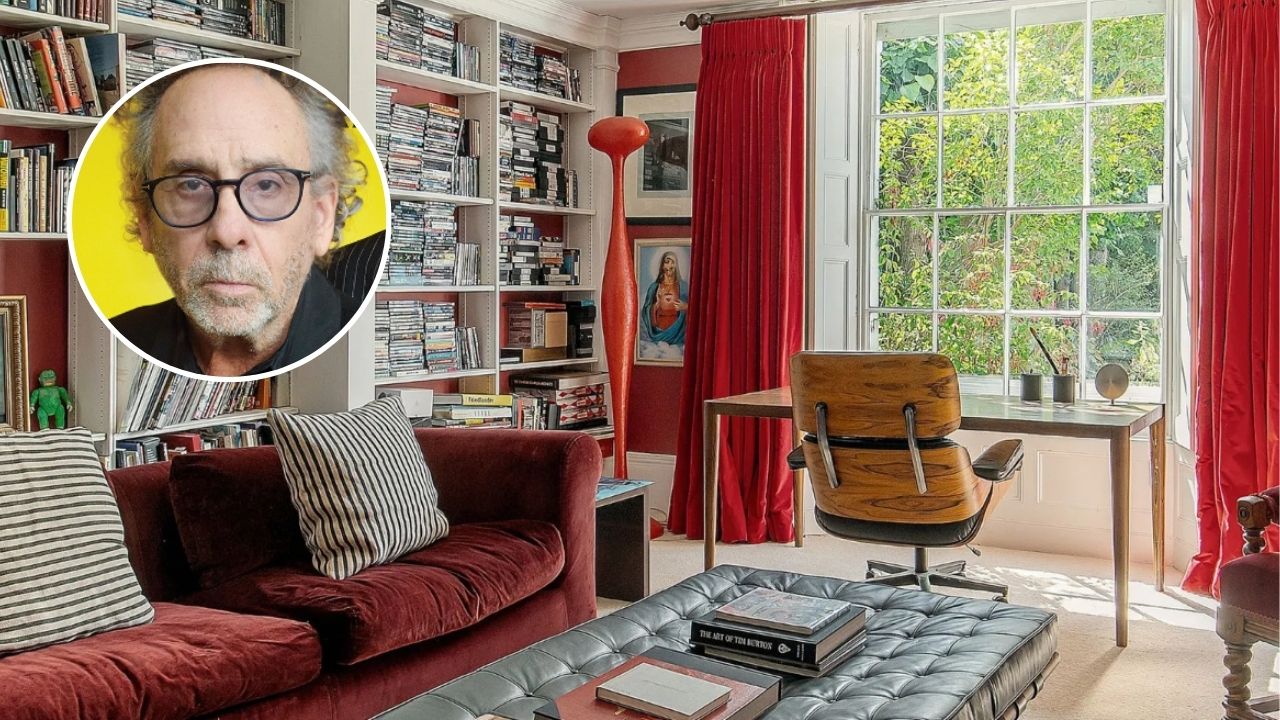
I thought I had moved past the Unexpected Red Theory, but Tim Burton’s library reminded me why it remains one of the most influential interior design concepts of the 2020s.
+ Video: Giant Umbrellas in Saudi Arabia; Innovation in Open Spaces
The red theory, which has won over architects and interior designers, shows how the strategic use of red can transform any space.
Amid vibrant colors and accent tones, there is a point of balance: inserting a striking shade in strategic spots to create visual impact without overwhelming the space. Tim Burton’s office, located in his Oxfordshire home (recently put up for sale), is a perfect example of this application. Here, the reinterpretation of the Unexpected Red Theory appears in curtains, a sofa, and a lamp, adding personality and cohesion to the space.

While the original concept advocates for a single red piece as the focal point, Burton shows that it is possible to use variations of this shade in different elements, creating harmony and reinforcing style. Amid the leather ottoman, natural wood desk, and white bookshelves, the space becomes a true catalog of textures, materials, and shades of red.
According to experts, red is ideal when used in small doses, following the 60-30-10 design rule: 60% dominant color, 30% secondary color, and 10% accent color. “The Unexpected Red Theory is one of today’s leading decorating trends because a single red item can instantly elevate a room,” explains trend expert Johanna Constantinou.
Just like red lipstick enhances a look, a touch of this tone in décor brings vibrancy, confidence, and sophistication. The secret is to balance it with neutral colors, such as white, beige, or natural wood, allowing the red to shine. Playing with different shades — from ruby to scarlet — ensures a dynamic and personality-filled environment, exactly as in Tim Burton’s office.
If you want to embrace the Unexpected Red Theory, start with a neutral base and add red accents in furniture, decorative objects, or fabrics. This simple yet powerful technique can transform any space without requiring a full renovation — proof that, even in 2025, this trend continues to set the pace for modern interior design.
Source: Homes & Gardens. This content was created with the help of AI and reviewed by the editorial team.
